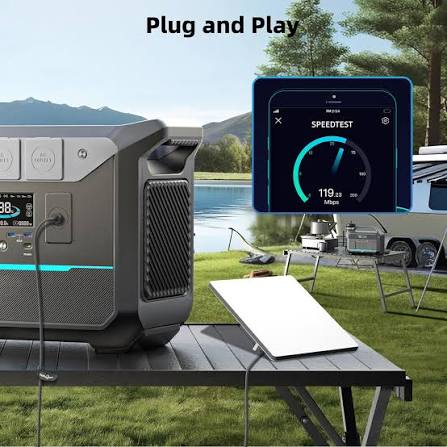
Best Portable Power Backup for Starlink High Performance Kit Kenya – Ultra-Detailed Battery, UPS & Solar Backup Guide 2026 The Starlink High Performance Kit is designed for stronger satellite internet performance in demanding environments such as businesses, lodges, mobile...
The Starlink High Performance Kit is designed for stronger satellite internet performance in demanding environments such as businesses, lodges, mobile operations, maritime use, remote offices, field deployments, RVs, construction sites, and high-usage locations. However, because the High Performance hardware consumes more power than Standard and Mini Starlink kits, choosing the right portable power backup system is very important.
Starlink support documentation lists Starlink Performance Gen 1 and Gen 2 power usage at around 110–150W average, while High Performance-related reseller specifications also list average usage in the same range. This makes backup sizing more serious than with the Starlink Mini or Standard Kit.
A good portable backup system for Starlink High Performance should provide:
stable pure sine wave AC power
enough battery capacity for the required runtime
surge protection
safe inverter output
solar charging support where needed
reliable operation during blackouts
portability for mobile and remote sites
| Item | Estimated Power Use |
|---|---|
| Starlink High Performance / Performance Kit | 110–150W average |
| Startup / peak demand | Can be higher temporarily |
| Router / networking equipment | 10–80W+ |
| Mesh router / access points | 10–100W+ |
| CCTV or office switch | 20–150W+ |
| Full field network setup | 180–500W+ |
Starlink’s support page lists Performance Gen 1 and Gen 2 average power usage at 110–150W, while Speedcast’s Flat High Performance specifications also list 110–150W average.
| Runtime | Estimated Energy Use for Dish Only |
|---|---|
| 1 hour | 110–150Wh |
| 4 hours | 440–600Wh |
| 8 hours | 880–1,200Wh |
| 12 hours | 1,320–1,800Wh |
| 24 hours | 2.64–3.6kWh |
| Situation | Why Backup Is Important |
|---|---|
| Power blackouts | Keeps Starlink online |
| Generator changeover | Prevents router reboot |
| Rural weak power | Stabilizes internet |
| Safari lodge use | Maintains guest connectivity |
| Construction site use | Keeps field teams connected |
| Office use | Supports cloud systems |
| CCTV use | Keeps surveillance online |
| Emergency response | Maintains communication |
Because the High Performance Kit draws more power than smaller Starlink systems, users should choose backup systems based on runtime, load, portability, and recharge method.
| Backup Type | Best Use | Recommended For |
|---|---|---|
| 500Wh power station | Short backup | Light temporary use |
| 1kWh power station | Half-day backup | Homes, offices, RVs |
| 2kWh power station | Full-day support | Lodges, field work |
| 5kWh power station | Long backup | Enterprise and remote sites |
| Solar generator kit | Off-grid backup | Rural and mobile deployments |
| UPS + lithium battery | Office continuity | Business networks |
| Backup Goal | Recommended Capacity |
|---|---|
| 2–3 hours | 500Wh |
| 4–6 hours | 1kWh |
| 8–12 hours | 2kWh |
| 24 hours | 3–5kWh |
| Multi-day backup | 5kWh+ with solar |
| Battery Capacity | Estimated Runtime for High Performance Kit |
|---|---|
| 500Wh | 3–4 hours |
| 1,000Wh / 1kWh | 6–8 hours |
| 1,500Wh | 9–12 hours |
| 2,000Wh / 2kWh | 13–16 hours |
| 5,000Wh / 5kWh | 33–40 hours |
These estimates assume 110–150W Starlink load before adding router, switches, inverter losses, weather conditions, and battery efficiency losses.
| Feature | Why It Matters |
|---|---|
| Pure sine wave AC output | Safer for electronics |
| 600W+ inverter rating | Handles startup and accessories |
| Solar input support | Useful for off-grid sites |
| UPS/EPS mode | Reduces reboot during outage |
| Lithium battery chemistry | Longer lifespan |
| Display monitoring | Tracks runtime and load |
For most High Performance users, a 1kWh to 2kWh portable power station is the best starting point, while lodges, offices, and remote sites should consider 3kWh to 5kWh+ systems.
| Setup | Recommended UPS |
|---|---|
| High Performance Kit only | 1500VA–2000VA |
| Kit + router | 2000VA |
| Kit + router + switch | 2000VA–3000VA |
| Office network stack | 3000VA–6000VA |
| Enterprise network room | 6kVA+ |
| UPS Size | Approximate Runtime |
|---|---|
| 1000VA | 10–25 minutes |
| 1500VA | 20–45 minutes |
| 2000VA | 30–60 minutes |
| 3000VA | 1–2 hours |
| UPS with external batteries | Several hours |
| UPS Feature | Benefit |
|---|---|
| Pure sine wave output | Cleaner power |
| AVR | Voltage stabilization |
| Surge protection | Protects hardware |
| External battery support | Longer runtime |
| Rackmount design | Better office setup |
| LCD monitoring | Easier management |
A UPS is excellent for short outages and generator changeover, but a portable power station or lithium inverter system is better for long runtime.
| Solar Size | Best Use |
|---|---|
| 300W solar panel | Light recharge support |
| 500W solar setup | Daily partial recharge |
| 800W solar setup | Stronger off-grid use |
| 1kW solar setup | Reliable daily recharge |
| 2kW+ solar setup | Business and lodge backup |
| Setup | Best For |
|---|---|
| 500Wh + 300W solar | Short camping backup |
| 1kWh + 500W solar | Home/RV backup |
| 2kWh + 800W solar | Field office backup |
| 5kWh + 1–2kW solar | Lodge or remote office |
| 10kWh+ hybrid system | Mission-critical sites |
| Location Type | Recommended Backup |
|---|---|
| Safari lodge | 5kWh + solar |
| Remote office | 2–5kWh + solar |
| Construction site | 2kWh portable station |
| RV / caravan | 1–2kWh + solar |
| Farm office | 2–5kWh lithium system |
| CCTV tower | Solar + lithium battery |
Solar backup is the best long-term solution for remote Kenyan sites where outages are frequent or generator fuel costs are high.
| Component | Recommendation |
|---|---|
| Battery capacity | 1kWh |
| Inverter | 600W+ pure sine wave |
| Runtime | 6–8 hours |
| Best for | Home backup, light office, RV |
| Component | Recommendation |
|---|---|
| Battery capacity | 2kWh |
| Inverter | 1000W+ pure sine wave |
| Solar input | 500–800W |
| Runtime | 13–16 hours |
| Best for | Construction sites, lodges, field teams |
| Component | Recommendation |
|---|---|
| Battery capacity | 5kWh+ |
| Inverter | 1500W–3000W pure sine wave |
| Solar input | 1kW+ |
| Runtime | 30+ hours |
| Best for | Hotels, lodges, NGOs, remote offices |
| User Need | Best Backup Choice |
|---|---|
| Short blackout protection | 1500VA–2000VA UPS |
| Full-day backup | 2kWh power station |
| Remote lodge use | 5kWh solar generator |
| RV/mobile setup | 1–2kWh portable station |
| Office networking | UPS + lithium battery |
| Off-grid use | Solar + lithium battery |
The best backup package depends on whether you need short protection, full-day runtime, mobile use, or long-term off-grid power.
When buying a portable power backup for the Starlink High Performance Kit, many users make the mistake of choosing a small power bank or low-capacity UPS without calculating the real power demand. Since High Performance Starlink systems consume more power than Standard or Mini kits, an undersized backup can shut down quickly, overload, or fail to support the router and networking devices.
This is why buying from Starlite Internet Kenya is a better choice. Starlite helps customers choose the right backup based on power consumption, runtime needs, mobility requirements, solar charging plans, and whether the setup is for a home, office, lodge, RV, construction site, or remote field team.
Starlite Internet Kenya also supports customers with UPS sizing, lithium battery recommendations, solar backup planning, inverter selection, surge protection, Starlink installation guidance, router placement, and network setup support. This is especially important in Kenya where power stability, rural deployments, and backup runtime needs vary widely from one site to another.
For customers who want reliable Starlink High Performance internet, Starlite Internet Kenya provides practical local guidance to help build a power backup system that keeps the connection stable during outages and remote operations.
Starlink lists Performance Gen 1 and Gen 2 power usage at around 110–150W average.
A 1kWh to 2kWh portable power station is suitable for many users, while remote sites may need 5kWh+.
Yes, but only for a few hours. A 500Wh unit may provide about 3–4 hours depending on load.
A UPS is good for short outages and generator changeover. For long outages, use lithium battery or solar backup.
Yes. Pure sine wave output is recommended for sensitive networking equipment.
Yes. A solar + lithium battery system can run it reliably if properly sized.
A 5kWh lithium backup with 1kW or more solar input is a strong option.
No. High Performance Starlink requires far more power than a phone power bank can provide.
A 600W+ pure sine wave inverter is the minimum practical starting point, while larger setups should use 1000W–3000W systems.
Only if the system includes surge protection, AVR, grounding, or quality UPS protection.
Yes. It helps prevent downtime during blackouts, voltage fluctuations, generator switching, and rural power instability.
From Starlite Internet Kenya for UPS, lithium batteries, solar backup, inverter sizing, and Starlink setup support.
The video above demonstrates how a portable power backup system can keep the Starlink High Performance Kit running during blackouts, outdoor deployments, RV use, construction work, and remote field operations. It highlights why battery capacity, inverter output, solar input, and runtime planning are important when powering a higher-consumption Starlink system.
It also explains key setup considerations such as choosing the correct power station size, avoiding undersized batteries, using pure sine wave output, planning solar recharge, protecting against surges, and supporting extra networking equipment such as routers, switches, and access points.
For Kenyan users, this video is especially useful for planning Starlink backup systems in lodges, offices, farms, RVs, construction sites, safari camps, NGOs, and remote locations where stable internet depends on both Starlink signal and reliable power.
The best portable power backup for the Starlink High Performance Kit should be sized for the kit’s higher power consumption, the desired runtime, and any extra networking equipment connected to the system.
It improves:
internet uptime
outage protection
mobile deployment reliability
remote work continuity
lodge and office connectivity
off-grid operation
equipment protection
long-term Starlink stability
For portable power stations, UPS systems, lithium batteries, inverter setups, solar backup systems, surge protection, and professional Starlink power planning, visit Starlite Internet Kenya and let Starlite Internet Kenya help you build a reliable Starlink High Performance backup solution anywhere in Kenya.
Hello! How can we help you today?
Start Chat